Underpin Settling Foundations With Engineered Steel Piers To Load-Bearing Strata
Epp Foundation Repair has driven engineered piers through Nebraska loess and Kansas clay since 1994. Helical, push, and slab piers, matched to the soil and the structure.
Let's take the first step toward a healthy home.
A local specialist will inspect your foundation, walk you through the findings, and send a clear estimate. no cost, no pressure.
What foundation underpinning is and when it's the right call.
Foundations settle because the soil under the footing fails to carry the structural load. The footing is doing its job. Spreading the building's weight over a wider area, but if the soil beneath that wider area is weak, organic, fill, or seasonally expansive, the footing moves with it. Loess soils across eastern Nebraska and western Iowa are particularly prone to settlement when wet because the loose silt structure collapses under load once water reduces particle friction (hydroconsolidation). Expansive clays farther south swell and shrink with moisture, lifting the foundation in spring and dropping it in fall until cumulative differential movement cracks the structure. Underpinning bypasses the failing soil. A steel pier is driven, pressed, or torqued through the weak zone until it reaches a load-bearing layer. Typically dense glacial till in Nebraska and Iowa (50 to 100-plus blow counts on a standard penetration test), or bedrock in some Missouri locations. Once the pier reaches refusal. Meaning it cannot advance further under the engineered driving force. The structural load transfers from the failing soil to the pier and down to the competent layer. The pier is mechanically connected to the existing footing with a steel bracket, and the building's weight is now riding on the pier rather than on the bad soil. The three pier types Epp Foundation Repair installs differ in how they reach load-bearing strata. Helical piers use a hydraulic motor to torque a steel shaft with welded helical plates into the ground; the torque required to advance the shaft correlates directly with soil bearing capacity, so the install crew knows exactly when load-bearing soil is reached. Helicals work well in soft soils where push piers cannot get adequate reaction, and they are removable, code-listed, and ICC-evaluated. Push piers use the structure's own weight as reaction load. A hydraulic ram presses 3.5-inch steel tube sections through the soil one at a time until the pier hits refusal at a calibrated pressure. Push piers install faster on heavier structures (full basement homes with masonry above), but require enough structural weight to push against. Slab piers are smaller-diameter helicals (typically 1.5 inch shaft) engineered for slab-on-grade homes where there is no basement wall to bracket to. The pier connects directly to the slab edge. Lift is a secondary operation. Once piers are in and load-transferred, hydraulic rams can attempt to raise the foundation toward original elevation. Lift success depends on soil failure mode, structure age, and how brittle the existing construction has become. Epp documents lift in laser-level measurements before and after, and provides written results. No verbal promises.
How we install foundation underpinning.
Site Assessment and Pier Plan
Epp Foundation Repair surveys the foundation with a laser level to map differential settlement to the quarter-inch, photographs all crack patterns, reviews the original construction (footing size, structure weight, soil type from county records), and decides between helical, push, or slab piers, and how many.
Engineered Plan and Permit
For projects where a structural engineer is involved (multi-family, commercial, or homeowner request), Epp coordinates the engineered drawing showing pier count, type, spacing, depth target, and bracket detail. The crew pulls local permits where required. The homeowner receives written confirmation of the scope before any work begins. No verbal change orders mid-job.
Access Excavation
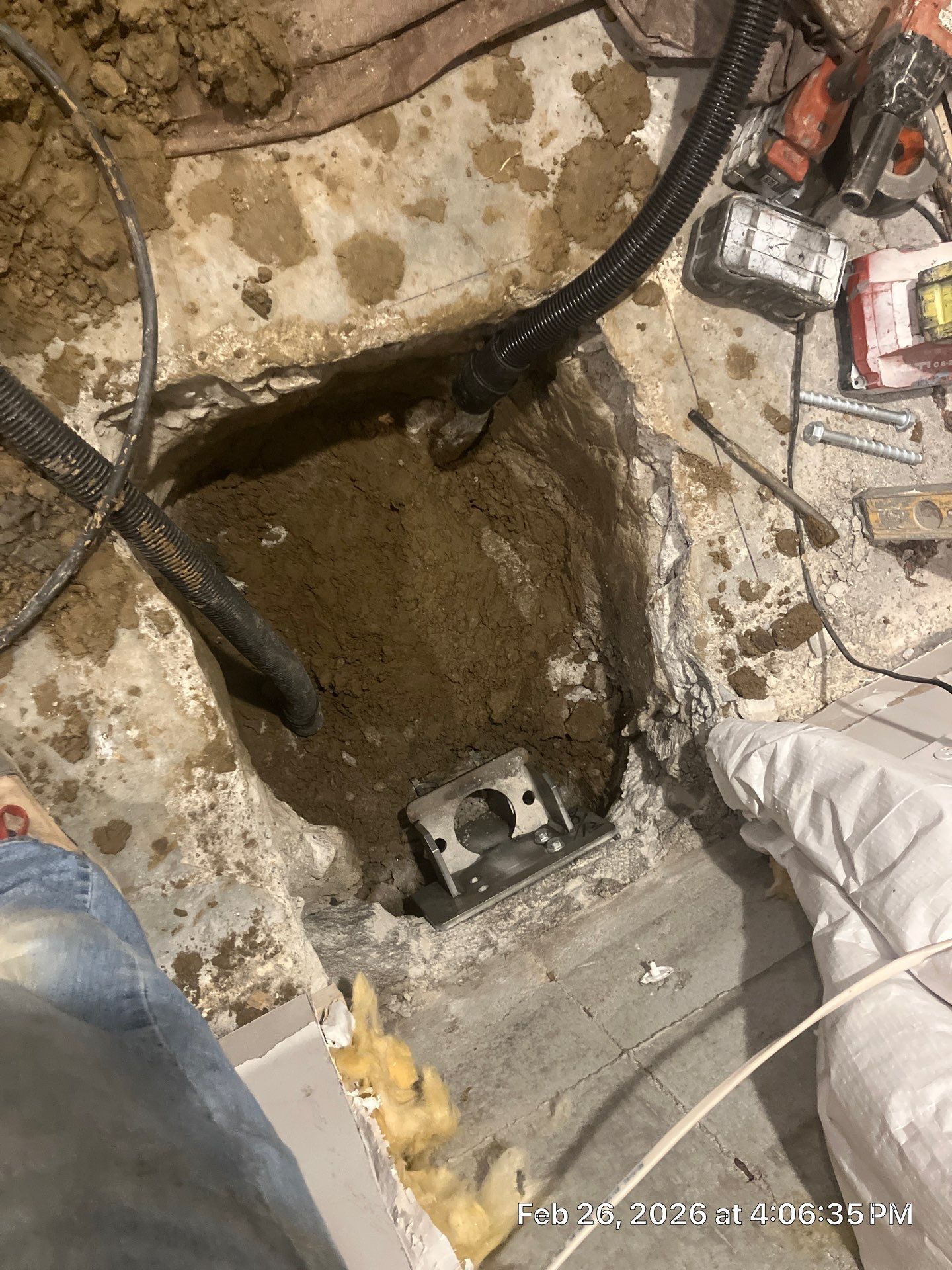
The crew hand-digs or mini-excavates access pits at each pier location along the exterior of the footing (or interior for some slab piers), typically 3 by 3 feet by 4 feet deep. The footing edge is exposed for bracket attachment. Spoils are stockpiled for clean backfill after the install.
"Stabilization is the contract. Lift is the goal we work toward and document, not the promise we sell. Anyone who guarantees you a half-inch of lift before they've put a laser on your footing is selling you something they can't deliver."

Care and expertise from a team that's been doing this since 1994.
Epp Foundation Repair is locally owned and operated, with crews dedicated exclusively to foundation, basement, and concrete work across the Midwest.
Foundation repair, waterproofing, and concrete leveling are our entire focus. not a sideline.
Three decades of experience with Midwest soils, basements, and weather conditions.
Recognized in 2011 and 2016 for ethical business practices and customer transparency.
Most product solutions carry 10 to 25-year warranties backed by the original installer.

Answers to common questions about Foundation Underpinning.
Don't see your question here? Our team is happy to help. Reach out anytime.
Other foundation repair solutions we install.
Every solution is engineered for a specific soil profile and failure mode. Browse the full toolkit.
Carbon Fiber Reinforcement
Epp Foundation Repair has reinforced bowed walls across Nebraska, Iowa, Kansas, and Missouri since 1994. No interior steel, no excavation, no lost basement space.
Learn moreDeep Foundation Systems
Epp Foundation Repair has stabilized settling structures across Nebraska, Iowa, Kansas, and Missouri since 1994 by carrying the load past weak surface soil to firm ground below. Stop the settlement, then attempt to recover what you can.
Learn moreEpoxy Crack Injection
Epp Foundation Repair has injected foundation cracks across Nebraska, Iowa, Kansas, and Missouri since 1994, and uses sequential polyurethane plus epoxy when one alone won't hold.
Learn moreExpansion Joints
Epp Foundation Repair has placed and resealed expansion joints across Nebraska, Iowa, Kansas, and Missouri since 1994. A good joint gives concrete room to move so it cracks where you want it to, not where you don't.
Learn moreHelical Deck Piers
Epp Foundation Repair has set helical deck piers across Nebraska, Iowa, Kansas, and Missouri since 1994. Steel screwed into firm ground holds a deck level through every freeze-thaw season.
Learn moreHelical Piers
When a foundation has settled into soft or eroding soil, surface-level repairs treat the symptom. Helical piers transfer the structure's load to deep bearing soil, stopping settlement permanently, often restoring lost elevation.
Learn moreServing Nebraska, Iowa, Kansas & Missouri.
Local crews based in six regional offices, dispatched daily across four states. If your town isn't listed, call us. we likely serve your area.
- Omaha, NE
- Lincoln, NE
- Des Moines, IA
- Ankeny, IA
- Topeka, KS
- Urbandale, IA
- Sioux City, IA
- West Des Moines, IA
- Bellevue, NE
- St. Joseph, MO
Take the first step toward a healthy home.
A straightforward path from initial inspection to completed repairs.
Schedule your inspection.
A local specialist visits your home, evaluates the foundation, and answers your questions on site. No cost, no obligation.
Receive an estimate based on your needs.
We provide a clear, written estimate with a scope of work tailored to your home's specific issues. Typically within one business day.
Get your repairs.
Our certified crews complete the work on schedule and back it with product warranties of up to 25 years.
Over 1,750 homeowners have shared their experience.
A 4.9-star average across Google, with verified reviews from homeowners throughout Nebraska, Iowa, Kansas, and Missouri.
Two ways to start: book instantly, or request an estimate.
Schedule your inspection in seconds with our Driive booking tool, or share a few details and a local specialist will follow up within one business day.
- A local foundation specialist on site
- A complete walk-through of the findings
- A written estimate within one business day
- No cost, no obligation, no high-pressure sales
Expert guidance on protecting your home.
Practical articles from the Epp team on foundation health, waterproofing, and home preservation.
 foundation-repairFeatured
Why foundation problems are common in Des Moines homes.
Iowa's expansive clay soils and freeze-thaw cycles are particularly hard on residential foundations. A practical guide to what's happening below grade and why local…