Helical Tieback Anchors Stabilize Tilting Retaining Walls Without Rebuilding
Epp Foundation Repair has anchored leaning block, poured-concrete, and timber retaining walls across Nebraska, Iowa, Kansas, and Missouri since 1994, pulling walls back into position at roughly 20 to 30 percent of full replacement cost.
Let's take the first step toward a healthy home.
A local specialist will inspect your foundation, walk you through the findings, and send a clear estimate. no cost, no pressure.
What retaining wall anchors is and when it's the right call.
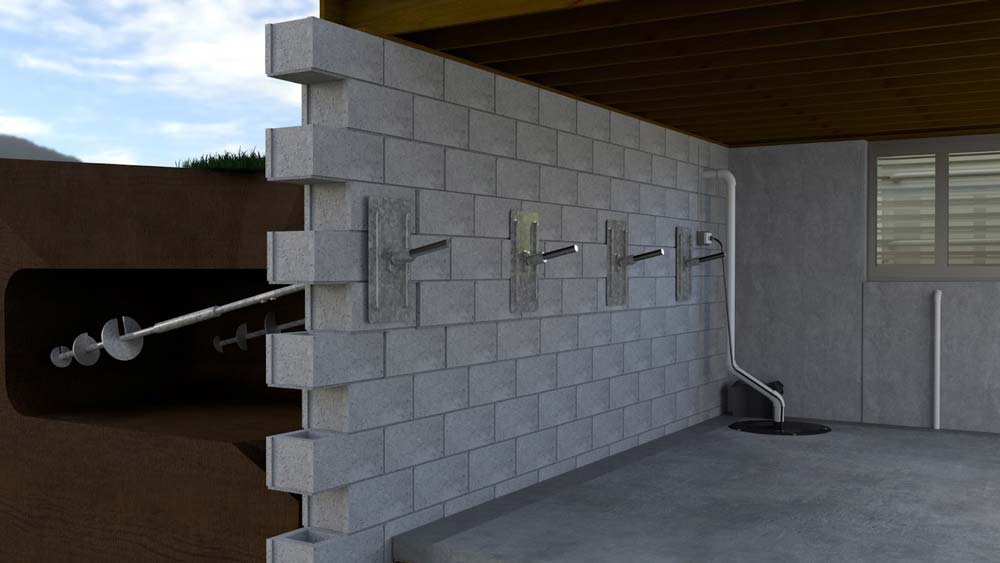
Retaining walls tilt outward because soil pressure behind the wall exceeds the wall's capacity to resist that pressure. The math is straightforward: a 6-foot block wall holds back a soil wedge that weighs roughly 100 pounds per cubic foot dry, and 120 to 130 pounds per cubic foot when saturated. Add freeze-thaw cycling. Common across all four states Epp serves, and the wall faces lateral loads that often exceed what unreinforced block or poured concrete was designed for. The wall starts to tilt at the top, mortar joints crack, and once the geometry moves out of plumb, gravity stops helping the wall and starts working against it. Helical tieback anchors reverse the failure mode by tying the wall back to stable native soil behind the failure zone. A small-diameter helical anchor. Typically 1.5-inch steel shaft with welded helical plates. Is driven horizontally through a pre-drilled hole in the wall face using a hydraulic torque motor. The crew advances the helical 8 to 15 feet into native soil behind the wall, past the active failure wedge, into ground that is not moving. Installation torque is monitored continuously, and the crew knows the helical has reached stable bearing soil when torque matches the engineered target. The anchor is then capped with a steel bearing plate against the wall face and tensioned with a calibrated wrench, transferring the lateral soil load from the wall fabric to the anchor in the deep soil. The geometry of the install matters. Anchors are typically installed at 4 to 6 feet on center horizontally and on multiple vertical rows for tall walls. The angle is normally 10 to 15 degrees downward into the soil to engage the helical in undisturbed native ground rather than the loose backfill immediately behind the wall. Tension is applied gradually. Epp routinely pulls a tilted wall back 1 to 3 inches toward plumb during install, and full restoration to original alignment is generally not achievable. The honest goal is to arrest movement and recover partial alignment, not to return the wall to as-built condition. Drainage behind the wall is a separate issue that anchors do not solve; if water is the root cause, the install includes a separate drainage scope, or Epp recommends rebuild with proper drainage tile rather than anchoring a wall that will keep accumulating pressure.
How we install retaining wall anchors.
Plumb Survey and Wall Fabric Assessment
Epp Foundation Repair measures wall plumb at multiple points along the length with a digital level or laser plumb line, documenting tilt to the quarter-inch at every measurement point. The crew inspects mortar joints, looks for separated courses, probes the backfill for organic content or saturation.
Anchor Layout and Engineered Plan
Anchors are laid out at 4 to 6 feet on center horizontally based on wall height, soil density, and tilt severity. Multiple vertical rows are specified for taller walls. The plan calls out anchor count, length, helical configuration, and tension target. For projects above an engineered threshold, a structural engineer's drawing is included.
Drilling Through the Wall Face
The crew drills a precise hole through each anchor location on the wall face, sized to the helical shaft diameter. On block walls, the drill enters at a mortar joint when geometry allows to minimize cracking. On poured concrete walls, a core bit cuts a clean hole.
"An anchor pulls the wall back against the soil it's tied into. If that soil is contaminated, if the wall is failing on its own, or if you don't fix the drainage, no anchor will save the wall. We measure all three before we quote the job."

Care and expertise from a team that's been doing this since 1994.
Epp Foundation Repair is locally owned and operated, with crews dedicated exclusively to foundation, basement, and concrete work across the Midwest.
Foundation repair, waterproofing, and concrete leveling are our entire focus. not a sideline.
Three decades of experience with Midwest soils, basements, and weather conditions.
Recognized in 2011 and 2016 for ethical business practices and customer transparency.
Most product solutions carry 10 to 25-year warranties backed by the original installer.

Answers to common questions about Retaining Wall Anchors.
Don't see your question here? Our team is happy to help. Reach out anytime.
Other foundation repair solutions we install.
Every solution is engineered for a specific soil profile and failure mode. Browse the full toolkit.
Carbon Fiber Reinforcement
Epp Foundation Repair has reinforced bowed walls across Nebraska, Iowa, Kansas, and Missouri since 1994. No interior steel, no excavation, no lost basement space.
Learn moreDeep Foundation Systems
Epp Foundation Repair has stabilized settling structures across Nebraska, Iowa, Kansas, and Missouri since 1994 by carrying the load past weak surface soil to firm ground below. Stop the settlement, then attempt to recover what you can.
Learn moreEpoxy Crack Injection
Epp Foundation Repair has injected foundation cracks across Nebraska, Iowa, Kansas, and Missouri since 1994, and uses sequential polyurethane plus epoxy when one alone won't hold.
Learn moreExpansion Joints
Epp Foundation Repair has placed and resealed expansion joints across Nebraska, Iowa, Kansas, and Missouri since 1994. A good joint gives concrete room to move so it cracks where you want it to, not where you don't.
Learn moreFoundation Underpinning
Epp Foundation Repair has driven engineered piers through Nebraska loess and Kansas clay since 1994. Helical, push, and slab piers, matched to the soil and the structure.
Learn moreHelical Deck Piers
Epp Foundation Repair has set helical deck piers across Nebraska, Iowa, Kansas, and Missouri since 1994. Steel screwed into firm ground holds a deck level through every freeze-thaw season.
Learn moreServing Nebraska, Iowa, Kansas & Missouri.
Local crews based in six regional offices, dispatched daily across four states. If your town isn't listed, call us. we likely serve your area.
- Omaha, NE
- Lincoln, NE
- Des Moines, IA
- Ankeny, IA
- Topeka, KS
- Urbandale, IA
- Sioux City, IA
- West Des Moines, IA
- Bellevue, NE
- St. Joseph, MO
Take the first step toward a healthy home.
A straightforward path from initial inspection to completed repairs.
Schedule your inspection.
A local specialist visits your home, evaluates the foundation, and answers your questions on site. No cost, no obligation.
Receive an estimate based on your needs.
We provide a clear, written estimate with a scope of work tailored to your home's specific issues. Typically within one business day.
Get your repairs.
Our certified crews complete the work on schedule and back it with product warranties of up to 25 years.
Over 1,750 homeowners have shared their experience.
A 4.9-star average across Google, with verified reviews from homeowners throughout Nebraska, Iowa, Kansas, and Missouri.
Two ways to start: book instantly, or request an estimate.
Schedule your inspection in seconds with our Driive booking tool, or share a few details and a local specialist will follow up within one business day.
- A local foundation specialist on site
- A complete walk-through of the findings
- A written estimate within one business day
- No cost, no obligation, no high-pressure sales
Expert guidance on protecting your home.
Practical articles from the Epp team on foundation health, waterproofing, and home preservation.
 foundation-repairFeatured
Why foundation problems are common in Des Moines homes.
Iowa's expansive clay soils and freeze-thaw cycles are particularly hard on residential foundations. A practical guide to what's happening below grade and why local…